这次 Namomo Summer Camp 2021 Day2 模拟选了这场
这场我们队AK了,排名6/107
讲个笑话,AK的全是中学生队伍,真正的大学生队伍没有一个AK的/youl
upd: 把队友写的题也补上了 现在全场题解都有了 Problem A. Broadcast Stations 通过队伍数:12/107
队友口述做法我写掉了
4h58min 通过,全场所有提交中最后一个AC记录/youl
题目大意:
有一棵
假设对于第
解法:
考虑树形dp。
令
然后发现不方便转移
再设
然后我们就可以愉快的推出转移方程了
1 2 3 4 5 6 7 8 9 10 11 12 13 14 15 16 17 18 19 20 21 22 23 24 25 26 27 28 29 30 31 32 33 34 35 36 37 38 39 40 41 42 43 #include <bits/stdc++.h> #pragma GCC optimize (2) #pragma G++ optimize (2) #pragma GCC optimize (3) #pragma G++ optimize (3) using namespace std;const int mxn=5005 ;int n;vector<int >G[mxn]; int f[mxn][mxn];int g[mxn][mxn];inline void dfs (int u,int fa=0 ) for (int i=0 ;i<=n;++i)f[u][i]=g[u][i]=n; vector<int >sum;sum.clear (); for (int i=0 ;i<=n+1 ;++i)sum.push_back (0 ); for (int i=0 ;i<G[u].size ();++i){ int v=G[u][i]; if (v==fa)continue ; dfs (v,u); for (int j=0 ;j<=n;++j)sum[j]+=g[v][j]; } for (int i=0 ;i<G[u].size ();++i){ int v=G[u][i]; if (v==fa)continue ; for (int j=0 ;j<n;++j)f[u][j]=min (f[u][j],f[v][j+1 ]+sum[j]-g[v][j]); } for (int i=1 ;i<=n;++i)f[u][i]=min (f[u][i],sum[i]+i); for (int i=n-1 ;i>=0 ;--i)f[u][i]=min (f[u][i],f[u][i+1 ]); for (int i=1 ;i<=n;++i)g[u][i]=min (g[u][i],sum[i-1 ]); g[u][0 ]=f[u][0 ]; for (int i=1 ;i<=n;++i)g[u][i]=min (g[u][i],g[u][i-1 ]); } int main () scanf ("%d" ,&n); for (int i=1 ;i<n;i++){ int a,b; scanf ("%d%d" ,&a,&b); G[a].push_back (b); G[b].push_back (a); } dfs (1 ); printf ("%d\n" ,f[1 ][0 ]); }
Problem B.Connect3 通过队伍数:53/107
题目大意:
有一个
现在告诉你黑棋第一步走了
题解:
直接爆搜
写了份屎山代码莽过去了
```cpp #include<bits/stdc++.h> >v){ >reget(int state){ >v;i;–i)for(int j=3;j;–j)v[i][j]=state%3,state/=3; >v){
for(int j=0;j<4;++j){
	if(v[0][j]==1 and v[1][j]==1 and v[2][j]==1)return 1;
	if(v[0][j]==2 and v[1][j]==2 and v[2][j]==2)return 2;
	if(v[3][j]==1 and v[1][j]==1 and v[2][j]==1)return 1;
	if(v[3][j]==2 and v[1][j]==2 and v[2][j]==2)return 2;
}

if(v[0][0]==1 and v[1][1]==1 and v[2][2]==1)return 1;
if(v[0][0]==2 and v[1][1]==2 and v[2][2]==2)return 2;
if(v[3][3]==1 and v[1][1]==1 and v[2][2]==1)return 1;
if(v[3][3]==2 and v[1][1]==2 and v[2][2]==2)return 2;
if(v[1][0]==1 and v[2][1]==1 and v[3][2]==1)return 1;
if(v[1][0]==2 and v[2][1]==2 and v[3][2]==2)return 2;
if(v[0][1]==1 and v[1][2]==1 and v[2][3]==1)return 1;
if(v[0][1]==2 and v[1][2]==2 and v[2][3]==2)return 2;

if(v[0][2]==1 and v[1][1]==1 and v[2][0]==1)return 1;
if(v[0][2]==2 and v[1][1]==2 and v[2][0]==2)return 2;
if(v[1][3]==1 and v[2][2]==1 and v[3][1]==1)return 1;
if(v[1][3]==2 and v[2][2]==2 and v[3][1]==2)return 2;
if(v[0][3]==1 and v[1][2]==1 and v[2][1]==1)return 1;
if(v[0][3]==2 and v[1][2]==2 and v[2][1]==2)return 2;
if(v[3][0]==1 and v[1][2]==1 and v[2][1]==1)return 1;
if(v[3][0]==2 and v[1][2]==2 and v[2][1]==2)return 2;

return 0;
} >v=reget(state); >v;
1
2
3
4
5
6
7
8
9
10
11
12
13
14
15
16
17
18
19
20
21
22
23
24
25
26
27
28
29
30
31
32
33
34
35
36
37
38
39
40
41
42
43
44
45
46
47
48
49
50
51
52
53
54
55
56
57
## Problem C.Game Map 通过队伍数:86/107 题目大意: 给你一张无向图。你需要找到一个路径$c_{1\dots len}$ 满足对于所有的$1 \le i < len$ 满足 $nei_{c_i}<nei_{c_{i+1}}$,其中 $nei_i$ 表示 $i$ 号节点的邻居数量。 题解: 签到题2号。 我们考虑记忆化搜索。令 $dp_i$ 表示考虑到当前以 $i$ 号节点为起始点的最长路径的长度是多少。 很显然这是没有后效性的,因为节点 $i$ 能辗转或直接到另一个节点 $j$ 当且仅当$nei_i<nei_j$,就不存在环状转移。 ```cpp #include<bits/stdc++.h> #define ll long long #define mp make_pair using namespace std; const int mxn=1e5+5; vector<int>g[mxn]; int n,m; int nei[mxn]; int dp[mxn]; inline int dfs(int x){ if(~dp[x])return dp[x]; dp[x]=1; for(int i=0;i<g[x].size();++i){ int y=g[x][i]; if(nei[y]>nei[x])dp[x]=max(dp[x],dfs(y)+1); } return dp[x]; } inline void solve(){ cin>>n>>m; for(int i=1,u,v;i<=m;++i){ cin>>u>>v; g[u].push_back(v); g[v].push_back(u); ++nei[v],++nei[u]; } int ans=0; memset(dp,-1,sizeof(dp)); for(int i=0;i<n;++i)ans=max(ans,dfs(i)); // for(int i=0;i<n;++i)cerr<<dp[i]<<' ';cerr<<'\n'; cout<<ans<<'\n'; } int main(){ ios_base::sync_with_stdio(false); cin.tie(0),cout.tie(0); int T;T=1; // cin>>T; for(;T--;)solve(); }
Problem D.Happy Number 通过队伍数:100/107
真·签到题
给你一个数。
定义一次操作为把一个数
比如:
定义一个数是 Happy Number 当且仅当经过若干次操作后会变为
如:
反之,就是 Unhappy Number
题目告诉你如果是 Unhappy Number 那一定会陷入一个循环
现在给你一个数 Happy Number
题解:
暴力即可。
虽然
但一次操作后就
可以发现无论怎么样也不会超过
然后由于会循环,直接暴力即可。
```cpp #include<bits/stdc++.h>
1
2
3
4
5
6
7
8
9
10
11
12
13
14
15
16
17
18
19
20
21
22
23
24
25
26
27
28
29
30
31
32
33
34
35
36
37
38
39
40
41
42
43
44
45
46
47
48
49
50
51
52
53
54
55
56
57
58
59
60
61
62
63
64
65
66
67
68
69
70
71
72
73
74
75
76
77
78
79
80
81
82
83
84
85
86
87
88
89
90
91
92
93
94
95
96
97
98
99
100
101
102
103
104
105
106
107
108
109
110
111
112
113
114
115
116
117
118
119
120
121
## Problem E.How Many to Be Happy? 通过队伍数:27/107 题目大意: 给你一张 $n$ 点 $m$ 边的带权无向图 令 $H(x):1\le x \le m$ 为让第 $x$ 条边能在最小生成树中最小需要删除的**边数**。 你现在需要求出 $\sum\limits_{i=1}^mH(i)$ $1 \le n \le 100, 1 \le m \le 500$ 题解: 我们观察对于第 $i$ 条边(连接 $u_i,v_i$ ,权值为 $w_i$ ),它要在最小生成树中需要满足什么条件。 按照 Kruskal 的思路,按照边权从小到大依次加边。那么所有边权 $\geq w_i$ 的边就没有影响不用考虑了。 然后考虑第 $i$ 条边什么时候能有用:就是在这之前 $u_i,v_i$ 不在一个连通块中。 稍微想一下就相当于在原图中求一个最小割。 以 $u_i$ 为源点,$v_i$ 为汇点,所有权值 $< w_i$ 的边都加上,容量为1。 在这张**无向图**上跑一遍最大流就行了。 注意是**无向图**,在建图的时候正边和反边的容量都是1。 ```cpp #include<bits/stdc++.h> #define ll long long #define mp make_pair using namespace std; #include<bits/stdc++.h> #define ll long long #define reg register #define mp make_pair #define ri register ll #define ld long double using namespace std; const ll mxn=2e5+5; ll n,m,s,t; struct edge{ll to,cap,rev;}; vector<edge>g[mxn]; inline void add_edge(ll from,ll to,ll cap){ g[from].push_back((edge){to,cap,g[to].size()}); g[to].push_back((edge){from,cap,g[from].size()-1});//无向图 } ll iter[mxn],lev[mxn]; const ll inf=21474836477777; inline void bfs(){ memset(lev,-1,sizeof(lev));lev[s]=0; queue<ll>q;for(;q.size();)q.pop();q.push(s); for(;q.size();){ ll p=q.front();q.pop(); for(ll i=0;i<g[p].size();++i){ edge&e=g[p][i]; if(e.cap>0 and lev[e.to]<0){ lev[e.to]=lev[p]+1; q.push(e.to); } } } } inline ll dfs(ll v,ll t,ll f){ if(v==t)return f; for(ll&i=iter[v];i<g[v].size();++i){ edge&e=g[v][i]; if(e.cap>0 and lev[e.to]>lev[v]){ ll d=dfs(e.to,t,min(f,e.cap)); if(d>0){ e.cap-=d; g[e.to][e.rev].cap+=d; return d; } } } return 0; } inline ll dinic(){ ll flow=0; for(;;){ bfs(); if(lev[t]==-1)return flow; memset(iter,0,sizeof(iter)); ll f=0; for(;;){ f=dfs(s,t,inf); if(!f)break; flow+=f; } } return flow; } vector<pair<pair<int,int>,int> >E; inline void solve(){ cin>>n>>m; for(int i=1,u,v,w;i<=m;++i)cin>>u>>v>>w,E.push_back(mp(mp(u,v),w)); ll ans=0; for(int i=0;i<m;++i){ memset(g,0,sizeof(g)); s=E[i].first.first,t=E[i].first.second; int f=E[i].second; for(int j=0;j<E.size();++j){ if(i==j)continue; if(E[j].second<f)add_edge(E[j].first.first,E[j].first.second,1ll); } ans+=dinic(); } cout<<ans<<'\n'; } int main(){ ios_base::sync_with_stdio(false); cin.tie(0),cout.tie(0); int T;T=1; // cin>>T; for(;T--;)solve(); }
Problem F.Philosopher’s Walk 通过队伍数:74/107
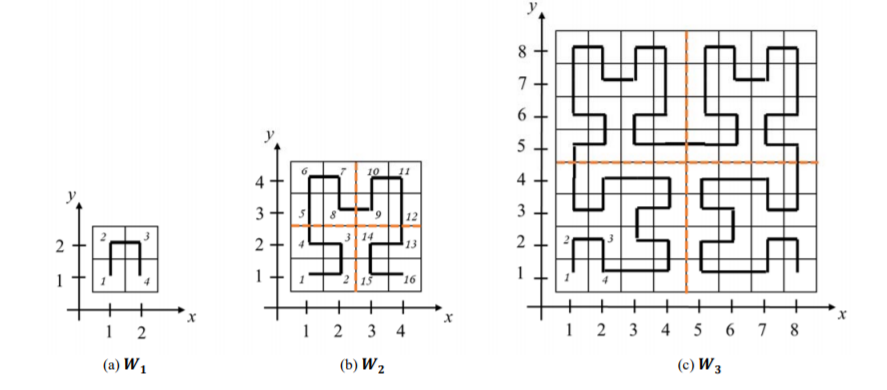
题目大意:
/youl
时间全花在看懂上
这分别是
现在给你
解法:
理解题意后可以发现大图是由小图转化而来。
所以我们可以不断的翻折、平移坐标系,从小往大推。
一个基础图形:左下->左上->右上->右下
递归小的后返回大的时考虑如何变化坐标系即可。
```cpp #include<bits/stdc++.h>
1
2
3
4
5
6
7
8
9
10
11
12
13
14
15
16
17
18
19
20
21
22
23
24
25
26
27
28
29
30
31
32
33
34
35
36
37
38
39
40
41
42
43
44
45
46
47
48
49
50
51
52
53
54
55
56
57
58
59
60
61
## Problem G.Rectilinear Regions 通过队伍数:16/107 题目大意: 给出两条阶梯型的线 $L,U$,求出那些 $U$ 在上,$L$ 在下围成的封闭的多边形的面积的和。  题解: 按照题意尺取法模拟。把一个大块分成一个个矩形求面积之和。 ```cpp #include<bits/stdc++.h> #define ll long long #define mp make_pair using namespace std; const int mxn=1e6+6; struct node{ ll x,y,t; }p[mxn]; ll n,m,nn,mm,lst=-1,pre,k; inline bool cmp(node x,node y){return x.x<y.x;} inline void solve(){ cin>>n>>m; cin>>nn;for(int i=0;i<n;++i)cin>>p[i].x>>p[i].y,p[i].t=0; cin>>mm;for(int i=0;i<m;++i)cin>>p[i+n].x>>p[i+n].y,p[i+n].t=1; sort(p,p+n+m,cmp); ll ans=0,cnt=0,sum=0; for(;k<n+m;){ int x=p[k].x; bool f=0; if(nn<mm)sum+=(x-pre)*(mm-nn);//求小块矩形面积之和 注意要先加到sum里,因为要求是封闭的多边形 可能最后一段不合上了 else f=1; for(;k<n+m and p[k].x==x;++k){ if(p[k].t==0)nn=p[k].y; else mm=p[k].y; } if(nn<mm and f)lst=x; else if(nn>=mm and !f){ if(lst>=0){ ++cnt; //同理 因为要求的是封闭多边形 ans+=sum; } sum=0; lst=x; } pre=x; } cout<<cnt<<' '<<ans<<'\n'; } int main(){ ios_base::sync_with_stdio(false); cin.tie(0),cout.tie(0); int T;T=1; // cin>>T; for(;T--;)solve(); }
Problem H.Rock Paper Scissors 通过队伍数:42/107
队友谦虚不会FFT就让我写了orz
题目大意:
有两个人玩石头剪刀布。他们的出法可以用两个字符串表示。每一个字符串的字符都为R P 或 S。显然 R 赢 S,S 赢 P,P 赢 R。
已知第一个人的串长度为
现在要从第一个人的串
现在需要最大化第二个人
题解:
这真的是FFT入门题啊
我们可以先将 S -> R,P -> S,R -> P,变为能赢的序列。
然后就是希望最大化
这不就是FFT模板了吗
对于 RGB 三种字符,我们分开来讨论:
假设现在考虑到 R:
构造两个多项式
然后将
同理得到
然后我们将
我们对
1 2 3 4 5 6 7 8 9 10 11 12 13 14 15 16 17 18 19 20 21 22 23 24 25 26 27 28 29 30 31 32 33 34 35 36 37 38 39 40 41 42 43 44 45 46 47 48 49 50 51 52 53 54 55 56 57 58 59 60 61 62 63 64 65 66 67 68 69 70 71 72 73 74 75 76 77 78 79 80 81 82 #include <bits/stdc++.h> #define ll long long #define reg register #define mp make_pair #define ri register int #define ld double using namespace std;const int mxn=6e5 +5 ;const ld PI=acos (-1 );int n,m,k,sm;int rev[mxn];complex<ld>F1[mxn],G1[mxn],F2[mxn],G2[mxn],F3[mxn],G3[mxn]; int A1[mxn],A2[mxn],A3[mxn];inline void makerev (int N) ri d=N>>1 ,p=0 ; rev[p++]=0 ,rev[p++]=d; for (int w=2 ;w<=N;w<<=1 ){ d>>=1 ; for (ri t=0 ;t<w;++t)rev[p++]=rev[t]|d; } } inline void FFT (complex<ld>*A,int N) for (ri i=1 ;i<N;++i)if (rev[i]>i)swap (A[rev[i]],A[i]); for (ri len=2 ,M=1 ;len<=N;M=len,len<<=1 ){ complex<ld>W (cos (PI/M),sin (PI/M)),w (1.0 ,0.0 ); for (ld L=0 ,R=len-1 ;R<=N;L+=len,R+=len){ complex<ld>w0=w; for (int p=L,lim=L+M;p<lim;++p){ complex<ld> x=A[p]+w0*A[p+M],y=A[p]-w0*A[p+M]; A[p]=x,A[p+M]=y; w0*=W; } } } } string a,b; int main () ios_base::sync_with_stdio (false ); cin>>n>>m>>a>>b; reverse (b.begin (),b.end ()); for (int i=0 ;i<n;++i){ if (a[i]=='R' )a[i]='P' ; else if (a[i]=='P' )a[i]='S' ; else if (a[i]=='S' )a[i]='R' ; } sm=n+m;k=1 ; for (;k<=sm;)k<<=1 ; makerev (k); for (int i=0 ;i<n;++i)if (a[i]=='R' )F1[i]=1 ; for (int i=0 ;i<m;++i)if (b[i]=='R' )G1[i]=1 ; FFT (F1,k); FFT (G1,k); for (int i=0 ;i<k;++i)F1[i]*=G1[i]; FFT (F1,k); reverse (F1+1 ,F1+k); for (int i=0 ;i<=sm;++i)A1[i]=(int )(F1[i].real ()/(ld)(k)+0.5 ); for (int i=0 ;i<n;++i)if (a[i]=='P' )F2[i]=1 ; for (int i=0 ;i<m;++i)if (b[i]=='P' )G2[i]=1 ; FFT (F2,k); FFT (G2,k); for (int i=0 ;i<k;++i)F2[i]*=G2[i]; FFT (F2,k); reverse (F2+1 ,F2+k); for (int i=0 ;i<=sm;++i)A2[i]=(int )(F2[i].real ()/(ld)(k)+0.5 ); for (int i=0 ;i<n;++i)if (a[i]=='S' )F3[i]=1 ; for (int i=0 ;i<m;++i)if (b[i]=='S' )G3[i]=1 ; FFT (F3,k); FFT (G3,k); for (int i=0 ;i<k;++i)F3[i]*=G3[i]; FFT (F3,k); reverse (F3+1 ,F3+k); for (int i=0 ;i<=sm;++i)A3[i]=(int )(F3[i].real ()/(ld)(k)+0.5 ); int ans=0 ; for (int i=m-1 ;i<=sm;++i)ans=max (ans,A1[i]+A2[i]+A3[i]); cout<<ans<<'\n' ; return 0 ; }
Problem I.Slot Machines 通过队伍数:49/107
题目大意:
给你一个长度为
你需要找到一对
现在需要
题解:
我们知道有个东西叫做
P3375 【模板】KMP字符串匹配
它是干什么用的?
求
定义一个字符串
然后题目怎么转化到这玩意上来?
翻转。
我们可以把数组
然后就是前缀重复了。
接着随便搞搞就行了。
1 2 3 4 5 6 7 8 9 10 11 12 13 14 15 16 17 18 19 20 21 22 23 24 25 26 27 28 29 30 31 32 33 #include <bits/stdc++.h> #define ll long long #define mp make_pair using namespace std;const int mxn=1e6 +6 ;int a[mxn],nxt[mxn],n;inline void kmp () nxt[0 ]=-1 ; for (int i=0 ,j=-1 ;i<=n;){ if (j==-1 or a[i]==a[j])nxt[++i]=++j; else j=nxt[j]; } } inline void solve () cin>>n; for (int i=0 ;i<n;++i)cin>>a[i]; reverse (a,a+n); kmp (); int ak=n-1 ,ap=1 ; for (int i=0 ;i<=n;++i){ int tp=i-nxt[i],tk=n-i; if (tp+tk<ak+ap)ak=tk,ap=tp; else if (tp+tk==ap+ak and tp<ap)ap=tp; } cout<<ak<<' ' <<ap<<'\n' ; } int main () ios_base::sync_with_stdio (false ); cin.tie (0 ),cout.tie (0 ); int T;T=1 ; for (;T--;)solve (); }
Problem J.Strongly Matchable 通过队伍数:10/107
题目大意:
给你一张
定义一种染色方案为,从中任意选出
定义一个图是“强完美匹配的”,当且仅当,对于所有的染色方案,白点集和黑点集都存在完美匹配。
你需要求出给你的这张图是不是“强完美匹配的”。
题解:
霍尔定理:对于黑点集的所有子集
由于要求任意染色都满足要求,所以我们直接考虑最坏情况:
对于一个黑点子集
那么
所以不合法的情况就是
得到
接下来就套路了?
设原点集为
令
这个
于是我们就可以对原图中于任意两个点
附:实际代码在比赛时 TLE 了一次,但神仙队友加了个随机化(对于每个源点随机只跑
Code by 神仙队友 miao22:
1 2 3 4 5 6 7 8 9 10 11 12 13 14 15 16 17 18 19 20 21 22 23 24 25 26 27 28 29 30 31 32 33 34 35 36 37 38 39 40 41 42 43 44 45 46 47 48 49 50 51 52 53 54 55 56 57 58 59 60 61 62 63 64 65 66 67 68 69 70 71 72 73 74 #include <bits/stdc++.h> using namespace std;const int MAX_V=203 ,INF=19260817 ;struct edge { int to,cap,rev; }; vector<edge> G[MAX_V]; int dist[MAX_V],prevv[MAX_V],preve[MAX_V],V;void add_edge (int from,int to,int cap) G[from].push_back ((edge){to,cap,G[to].size ()}); G[to].push_back ((edge){from,0 ,G[from].size ()-1 }); } void add_edge2 (int from,int to,int cap) G[from].push_back ((edge){to,cap,G[to].size ()}); G[to].push_back ((edge){from,cap,G[from].size ()-1 }); } void init () for (int i=0 ;i<V;i++)G[i].clear (); } int q[MAX_V];int max_flow (int s,int t) int res=0 ; while (1 ){ for (int i=0 ;i<V;i++)dist[i]=19260817 ; dist[s]=0 ; int nws=0 ,nwt=0 ;q[0 ]=s; while (nws<=nwt){ int nw=q[nws++]; for (int i=0 ;i<G[nw].size ();i++) if (G[nw][i].cap&&dist[G[nw][i].to]==19260817 ){ dist[G[nw][i].to]=dist[nw]+1 ; q[++nwt]=G[nw][i].to; prevv[q[nwt]]=nw; preve[q[nwt]]=i; } } if (dist[t]==INF) return res; int d=19260817 ; for (int v=t;v!=s;v=prevv[v]) d=min (d,G[prevv[v]][preve[v]].cap); res+=d; for (int v=t;v!=s;v=prevv[v]){ edge &e=G[prevv[v]][preve[v]]; e.cap-=d; G[v][e.rev].cap+=d; } } }int n,m,a[5053 ],b[5053 ]; int main () cin>>n>>m; for (int i=0 ;i<m;i++){ scanf ("%d%d" ,a+i,b+i); a[i]--;b[i]--; }V=2 *n; srand (time (NULL )); for (int i=0 ;i<n;i++){ int j,cnt=10 ; while (cnt--){ j=rand ()%(n-i)+i; init (); for (int k=0 ;k<n;k++) add_edge (k,k+n,1 ); for (int k=0 ;k<m;k++){ add_edge (a[k]+n,b[k],233 ); add_edge (b[k]+n,a[k],233 ); } if (max_flow (i+n,j)<n/2 ){ cout<<-1 ; return 0 ; } } }cout<<1 ; }
Problem K.Untangling Chain 通过队伍数:36/107
题目大意:
在二维平面上,从
你还需要输出一种方案。
题解:
神仙队友:这是诈骗题,秒了!
的确挺诈骗的
他只是说要不相交,没有要求改动最小
所以我们可以尝试螺旋走位。
记录当前的
Code by miao22 :
1 2 3 4 5 6 7 8 9 10 11 12 13 14 15 16 17 18 19 20 21 22 23 24 25 26 27 28 29 30 31 #include <bits/stdc++.h> using namespace std;char c[4 ]={'R' ,'U' ,'L' ,'D' };int x[2 ],y[2 ],nwx,nwy,n,pt;int main () cin>>n; while (n--){ int tmp;cin>>tmp>>tmp; if (c[pt]=='U' ){ cout<<y[1 ]+1 -nwy<<' ' ; nwy=y[1 ]+1 ; y[1 ]=nwy; } if (c[pt]=='L' ){ cout<<nwx-x[0 ]+1 <<' ' ; nwx=x[0 ]-1 ; x[0 ]=nwx; } if (c[pt]=='D' ){ cout<<nwy-y[0 ]+1 <<' ' ; nwy=y[0 ]-1 ; y[0 ]=nwy; } if (c[pt]=='R' ){ cout<<x[1 ]+1 -nwx<<' ' ; nwx=x[1 ]+1 ; x[1 ]=nwx; } pt=(pt+tmp+4 )%4 ; } }
Problem L.Vacation Plans 通过队伍数:14/107
题目大意:
有
有
假设当前一个人在
问你最小的代价使得在所有人同时出发的前提下同时到达终点。
题解:
留在原地相当于连一条
按照时间分层dp。
我们对每个图分开来考虑。
令
按照拓扑序直接暴力转移即可。
然后统计答案。
枚举一个同时到达终点的时间
这一时刻的答案就是
1 2 3 4 5 6 7 8 9 10 11 12 13 14 15 16 17 18 19 20 21 22 23 24 25 26 27 28 29 30 31 32 33 34 35 36 37 38 39 40 41 42 43 44 45 46 47 #include <bits/stdc++.h> #define ll long long #define mp make_pair using namespace std;#define int ll const int mxn=55 ;const int lim=mxn*mxn*mxn;struct graph { vector<pair<int ,ll> >g[mxn]; ll dp[lim][mxn],n,m,to; inline void read () cin>>n>>m; memset (g,0 ,sizeof (g)); for (int i=1 ,w;i<=n;++i)cin>>w,g[i].push_back (mp (i,w)); for (int i=1 ,u,v;i<=m;++i){ ll w; cin>>u>>v>>w; g[u].push_back (mp (v,w)); } cin>>to; } inline void go () for (int i=0 ;i<lim;++i)for (int j=0 ;j<=n;++j)dp[i][j]=1145141919810 ; dp[0 ][1 ]=0 ; for (int t=0 ;t<lim;++t)for (int i=1 ;i<=n;++i)for (pair<int ,ll>p:g[i])dp[t+1 ][p.first]=min (dp[t+1 ][p.first],dp[t][i]+p.second); } inline ll get (int x) return dp[x][to];} }G[4 ]; inline void solve () int cc;cin>>cc; for (int i=1 ;i<=cc;++i)G[i].read (),G[i].go (); ll ans=1145141919810 ; for (int t=0 ;t<lim;++t){ ll tmp=0 ; for (int i=1 ;i<=cc;++i)tmp+=G[i].get (t); ans=min (ans,tmp); } cout<<ans<<'\n' ; } signed main () ios_base::sync_with_stdio (false ); cin.tie (0 ),cout.tie (0 ); int T;T=1 ; for (;T--;)solve (); return 0 ; }